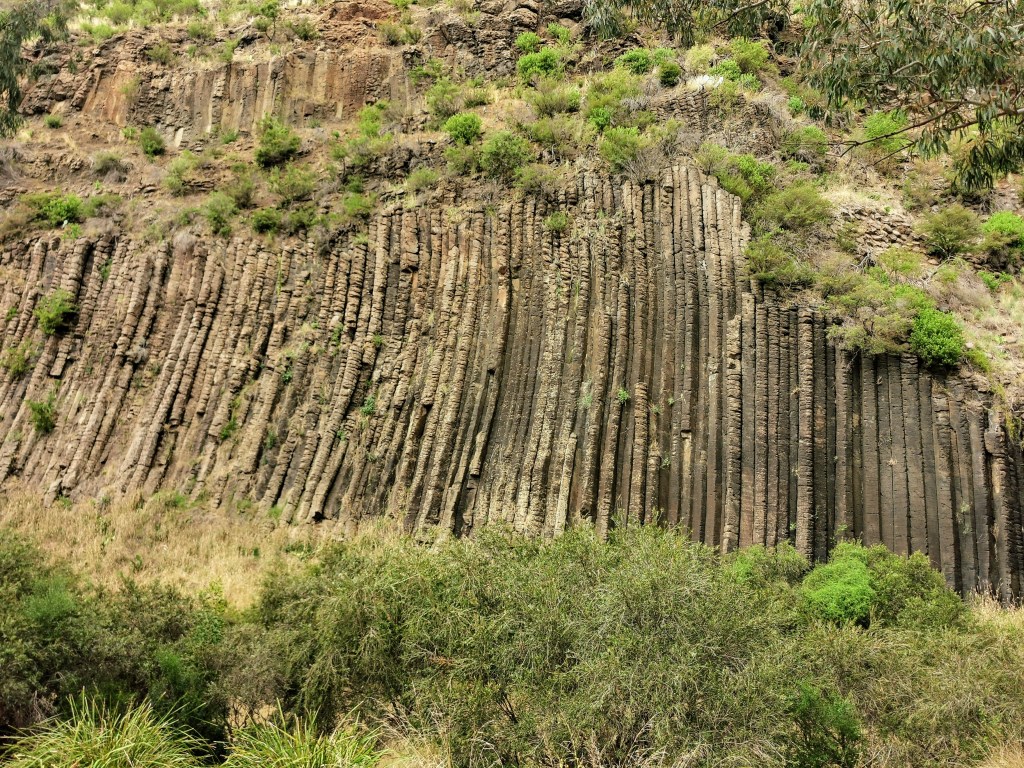
Nestled a mere 30 kms from the vibrant heart of Melbourne, the Organ Pipes National Park stands as a geological masterpiece, often bypassed by many.
This concealed treasure had lingered on my exploration wishlist for quite some time. Last year, however, as chance would have it, the gaps in pandemic-induced lockdowns aligned, giving us an opportunity to visit this extraordinary landscape. Accompanied by friends, we embarked on this journey, and were awestuck seeing it.
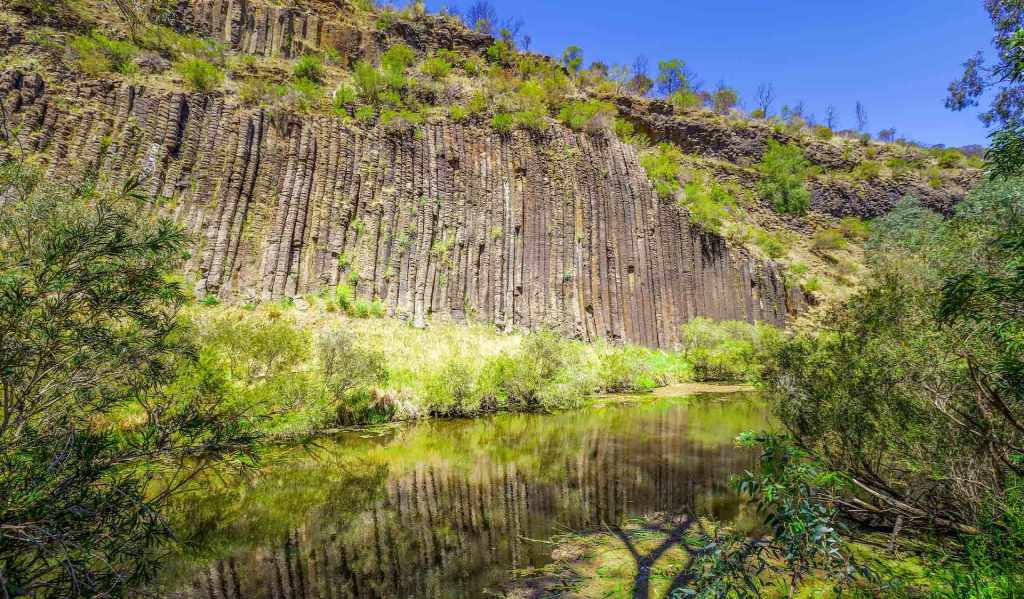
As you journey beyond the reaches of urban sprawl and suburban landscapes of Melbourne city, an entirely different lanscape greets you.
The Organ Pipes National Park resides at the far eastern edge of one of the planet’s most massive ancient volcanic lava flows and stretches an astonishing 350 kms from the outskirts of Melbourne to the western reaches of Victoria. The Basalt Keilor Plains, part of this colossal lava flow, stand as a silent witness to the molten fury that once erupted from volcanoes near Sunbury. Carved into this terrain are deep valleys, formed over time by streams like the meandering Jacksons Creek.
Long before modern times, the Woiworung tribe of the Kulin nation held sway over this land. Drawn by the allure of shelter, water, and sustenance along Jackson Creek, they were the earliest inhabitants of the region. The abundant rainfall, a consequence of Organ Pipes National Park’s location within a rain shadow area, fostered the proliferation of wild grasses across the Keilor Plains. This vibrant ecosystem nurtured a flourishing community of birds and animals.
Bit of History
Archaeological finds in the park unearth more than just remnants; they reveal stories of ancient campsites and artifacts, offering genuine proof of the Woiworung tribe’s presence, embedding their history within the landscape. Early European settlers introduced flora and hunted kangaroos and rabbits, straining the delicate ecosystem. Their good intentions led to unintended consequences and the once-wild creek flat grasses choked under invasive artichoke thistles, horehound, and boxthorn. While most invasive plants have been managed or removed, traces of this interaction remain. Plum tree orchards from those times endure. Sturdy bluestone walls, the settlers’ foundations, stand as tangible echoes of their existence, offering insight into an era shaped by the interplay of humanity and nature.
How did these form
As the molten lava within the basalt cooled over time, a captivating geological process unfolded. The interior molten lava, often known as trap rock, experienced fractures due to the cooling and shrinkage. This shrinkage led to tension within the rock mass. While vertical tension found release in the elastic molten rock below, horizontal tension presented a challenge, resulting in basalt fractures. These fractures typically took on hexagonal shapes, some even boasting up to eight sides. This formation occurred while the rock was still remarkably hot, around 400°C (752°F). Further contraction occurred as the rock shed its residual heat. This contraction-induced tension found relief through horizontal cracking, yielding columns resembling stacked Dutch cheese. This intricate dance of cooling, shrinkage, and tension crafted the breathtaking basalt formations that captivate us today.
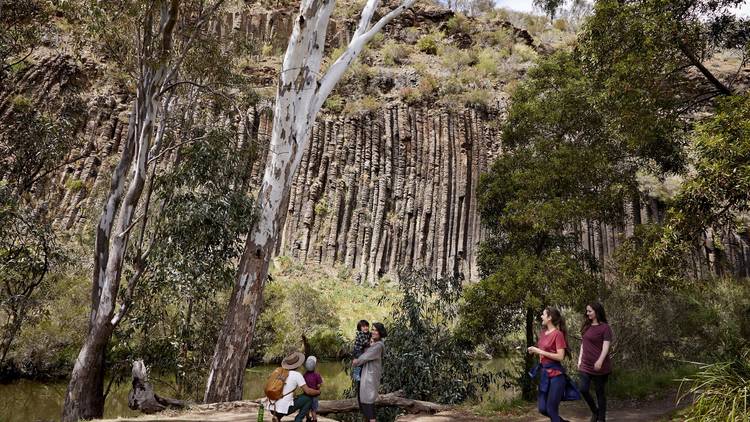
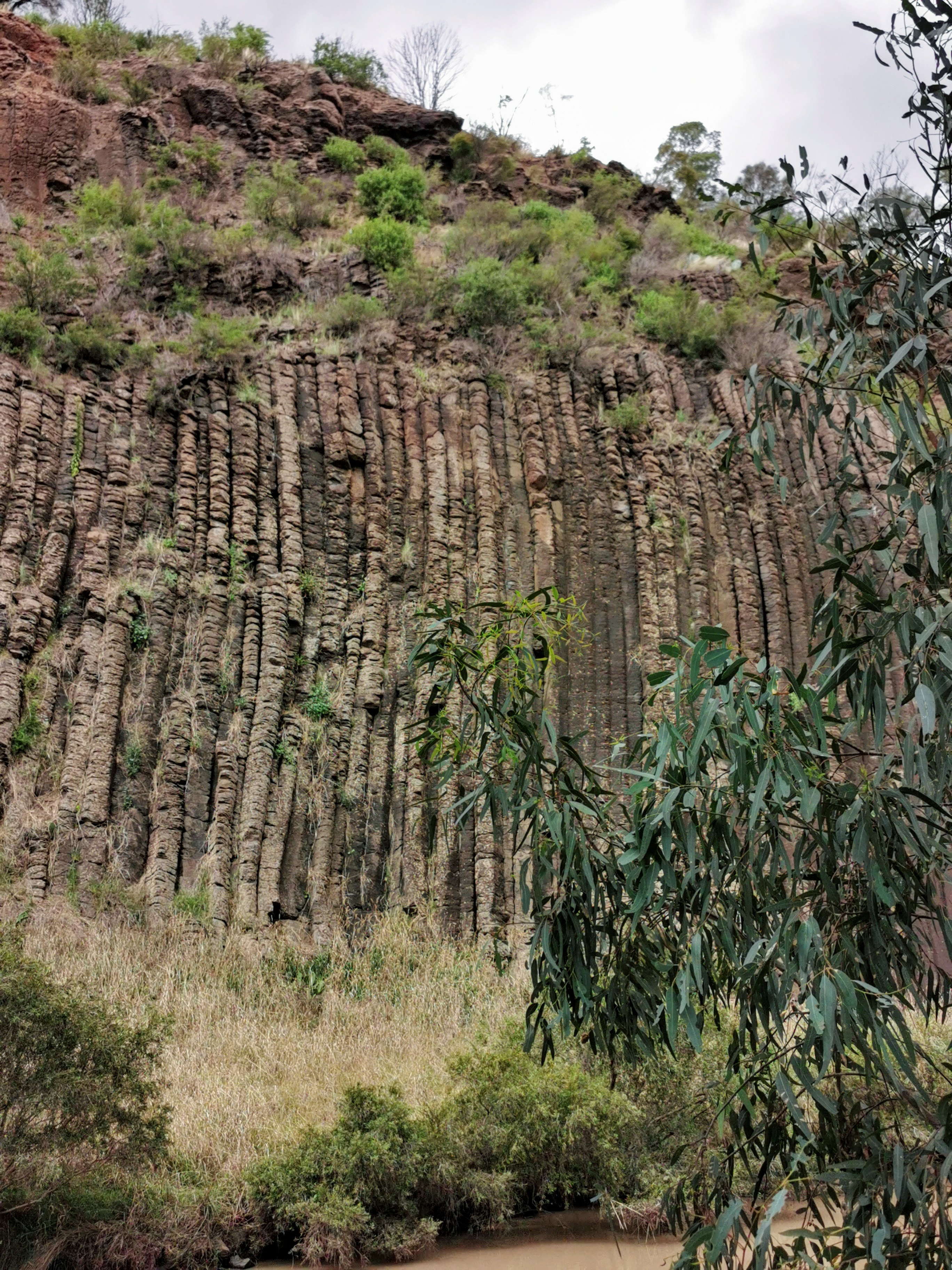
Gazing up at the ‘Basalt Columns’ that tower over Jackson’s Creek, we marveled at their resemblance to actual organ pipes! The sight was a product of the cooling and fracturing of molten lava, etching a name that fittingly stuck. The realization that we stood atop a volcano that roared to life around 2.5 to 2.8 million years ago left me awestruck. Our curious son, too, couldn’t contain his excitement in the face of this incredible geological testament and has become more inquisitive to learn more about such places and wonders.
Don’t miss the chance to observe the fossilized traces left behind by sea snails, sea worms, and ancient aquatic creatures in the sandstone bedrock. These fascinating imprints date back an astonishing 400 million years. A journey through time, these fossils are a glimpse into a distant past when the park’s surroundings were vastly different.
The presence of these fossils intertwined with the sandstone bedrock offers a window into the distant epoch when the very landscape was submerged beneath the waters of an ancient ocean. As you traverse the park’s pathways, this subtle reminder of its oceanic origins is a testament to the ever-evolving nature of our world.
The anticipation was real as we ventured to witness the wonders that lay ahead: Rosette Rock, the Tessellated Pavement, and the striking Sconia Cone.
Rosette Rock
500 meters upstream of the Organ Pipes, is a captivating wonder that welcomes those who tread the Left River Trail. This intricate pattern, reminiscent of the spokes of an immense wheel, has aptly earned the name “Rosette Rock.”
The genesis of this natural marvel is a testament to the intricate dance of geological forces. Picture a pocket of lava, ensconced within a spherical cave forged by a previous lava flow. As this lava cooled, a radial pattern emerged, akin to the gradual cooling of a fire’s embers. This captivating sight, etched into the very fabric of the landscape, stands as a tribute to the remarkable journey of Earth’s elements.
Tessellated Pavement
Journeying forward 300 meters from Rosette Rock, you’ll reach the Tessellated Pavement—an alternate expression of nature’s artistry. Crafted from the same columnar basalt as the Organ Pipes, these formations share an origin in the flow of lava. Yet, the Tessellated Pavement’s tale is distinct, influenced by Jackson’s Creek. The outcome is a captivating mosaic-like erosion, akin to well-worn tiles. Etched into the valley floor, it adds geometric elegance to the surroundings. Unlike the towering grandeur of the Organ Pipes, the Tessellated Pavement offers a more personal encounter. Its horizontal layout invites exploration and ascent. Take caution as our access, while granting us a view of its splendor, also poses a risk to its preservation. Protecting this masterpiece hinges on our conscientious exploration.
Scoria Cone: A Geological Highlight
The park’s car park sits atop this ancient cone, formed by explosive eruptions around the same time as larger volcanoes to the north (800,000 to a million years ago). These eruptions hurled molten rock into the air, giving birth to scoria; a volcanic rock known for its brownish hue and air pockets. This cone’s history and the scoria it generated stand as a testament to the park’s geological legacy, offering insights into the powerful natural forces that shaped the landscape.
Curiously, even the very car park where we left our vehicle rests atop an eroded scoria cone which was a miniature volcano that once spewed forth molten volcanic rock known as scoria. We picked up a ‘Scoria Stone,’ which has reddish-brown hue and is lightweight nature; complete with the air holes that formed from the steam trapped within during the eruption.
Explore more nearby
Keilor Historical Village (10 mins)
A restored 1850s village that tells stories of Victoria’s early settlers and gold rush era.
Brimbank Park (15 mins)
Larger bushland area with picnic spaces, walking tracks along the Maribyrnong River, and a great café overlooking the wetlands.
Sunbury Wine Region (20 mins)
Explore boutique wineries like Goona Warra or Craiglee, known for historic cellars and cool-climate shiraz.
Living Legends (Woodlands Historic Park, 25 mins)
Home to retired champion racehorses and kangaroos — set within scenic walking trails.
Essendon Fields or Highpoint Shopping Centre (30 mins)
Perfect for a quick bite or detour before heading home.
Location & Distance Guide
Address: Organ Pipes Rd, Keilor North VIC 3036
(It is located just off the Calder Freeway about 20 km North-West of Melbourne)
Walking Distance: 3.1 km
Time: 45 min to 1 Hour
Walking Trail: Easy to Moderate. Although I found it a bit hard to climb up the steep hill on my return but could do it with multiple tiny breaks!
As we left the Organ Pipes National Park, we carried with us a sense of connection to both the ancient past and the present moment, reminded once again of nature’s captivating ability to shape our world across millennia.
Organ Pipes National Park isn’t just about rocks but about witnessing the Earth’s patience. What looks like stillness is actually a frozen moment of ancient movement, shaped by fire, cooled by time, and softened by the passage of life around it. It’s a reminder that even just 30 minutes from the city, there are places that encourage you to pause, listen, and see how naturally calm the world can be.
From Melbourne: 29.1 km via M2 and Calder Fwy/M79
Melton: 20.2 km via Melton Hwy/C754
Essendon: 15 km
Footscray: 20 km
Glen Waverley: 50 km
Bendigo: 150 km
Important Information:
- Park Timings: 8:30 Am – 6:00 Pm
- Parking & Entry Fee: Free
- Public toilet facilities are available, ensuring a comfortable experience.
- Pets or dogs, unfortunately, aren’t allowed within the park’s boundaries.
- Keep a watchful eye for snakes, particularly in the vicinity of water bodies.

 Local Vic