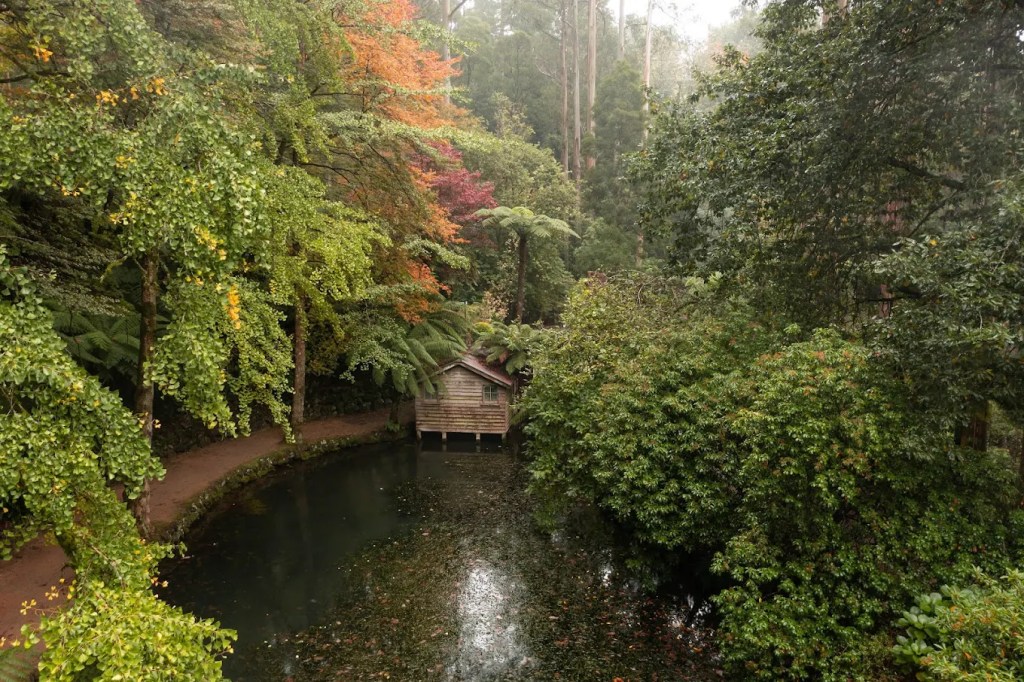
Picture an ornamental lake reflecting the surrounding Mountain Ash forest, its surface broken only by a charming boathouse that’s become one of the Dandenongs’ most iconic images; that for everyone is the heart of Alfred Nicholas Memorial Gardens.
A Pharmaceutical Empire’s Garden Paradise
The story of Alfred Nicholas Memorial Gardens begins with aspirin. In 1915, when World War One cut off German supplies of acetylsalicylic acid, brothers George and Alfred Nicholas used borrowed kitchen utensils and kerosene tins to create Australia’s first aspirin, naming it “Aspro”.
Their pharmaceutical empire made them extraordinarily wealthy, and in 1929, Alfred Nicholas purchased land in Sherbrooke and began assembling what would become a 13-hectare (32-acre) mountain estate – Burnham Beeches (a spectacular three-storey Streamline Moderne mansion, built 1933-34 was in ruins and has recently been taken up for historic renovations).
Read more
Nicholas hired 60 workers to clear the land, then traveled to England’s Chelsea Flower Show in 1929 where he purchased plants and met Percival Trevaskis, a Cornishman who would become his head gardener. 150 trees were shipped from England to Melbourne and transported up to the mountain property! The property was named Burnham Beeches after the English National Forest of beech trees in Buckinghamshire which was located near Nicholas’s United Kingdom Aspro factory.
The gardens were designed by renowned landscape architect Hugh Linaker, best known for his work on Melbourne’s Shrine of Remembrance and Domain, creating bold terraces, dramatic rockeries, and elaborate water features to control the steep mountain terrain.
Tragically, Alfred Nicholas passed away in 1937, just after the gardens were established, leaving his wife Isobel who remained at the property on and off until 1954. The mansion served as a children’s hospital during World War Two, became a research facility for the Nicholas Institute in the 1950s, and the gardens were donated to the Shire of Sherbrooke in 1965 (transferred to Parks Victoria in 1973) as a memorial to Alfred Nicholas.
The garden today are the jewel of the Dandenongs
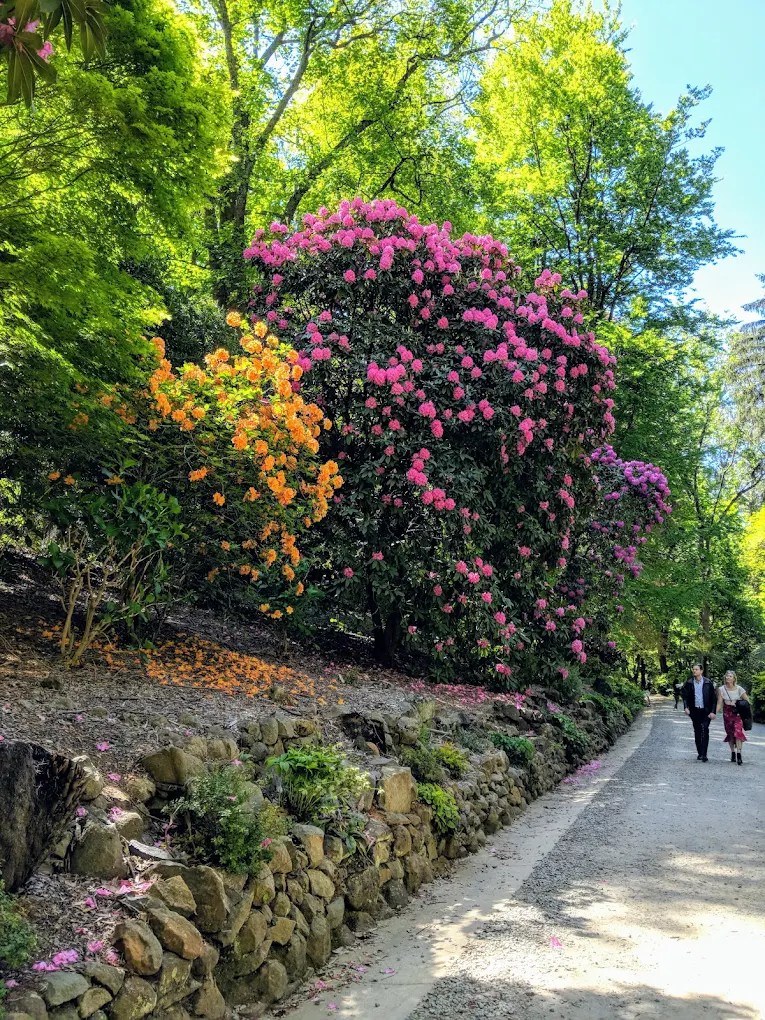
Today the garden is a public treasure that paints a diffrent landscape every season. Spring brings explosions of rhododendrons, azaleas and flowering cherries; summer sees hydrangeas and fuchsias take center stage; autumn transforms the garden into a gallery of gold and crimson as maples, ginkgos and beech trees change; winter offers early camellias and the stark beauty of bare branches reflected in still water. The garden collection includes 40% Australian native plants alongside imported specimens, creating a diverse botanical showcase.
Upper Garden: Moss-Covered Ponds and Hidden Bridges
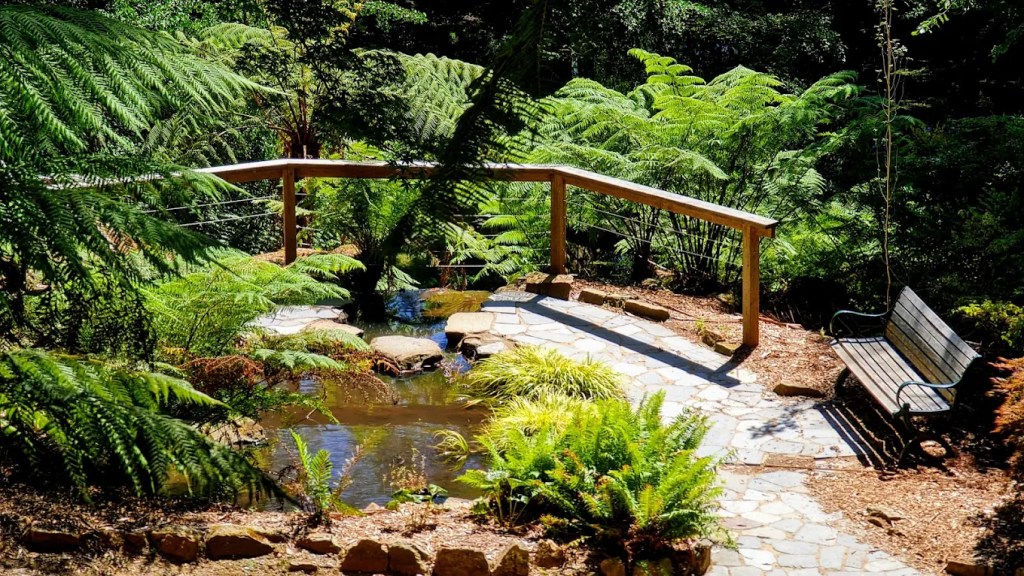
At the top of the garden near the entrance, visitors discover moss-covered ornamental ponds on either side of the original drive, connected by small stone-paved paths and delicate bridges that cross the water.
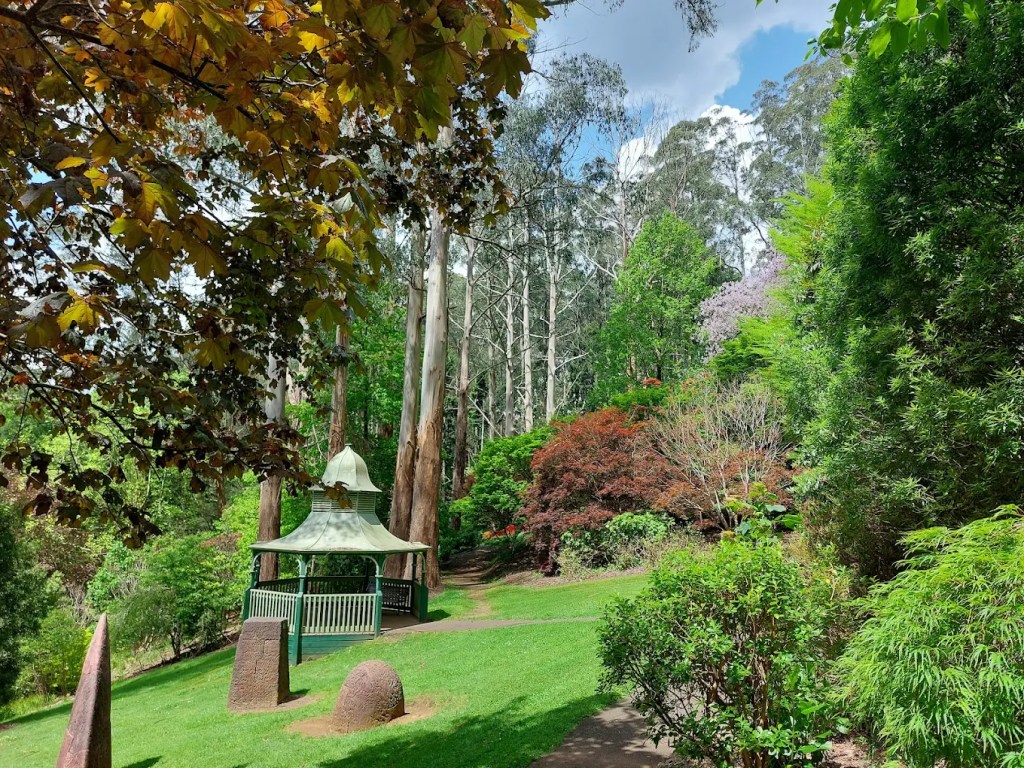
The upper ponds have a calm and welcoming feel. A large terraced rock garden shapes much of the area, with stone walls separating the levels and creating small pockets for plants to grow. The steep land has been carefully managed using terraces, paths, water features, and strong stonework in the walls and walkways. The layout refelts how thoughtfully the garden was designed. The original set of steps runs across the terraces, connecting the different levels. Several walking paths cross the garden, giving visitors many ways to explore.
The Iconic Ornamental Lake and Boathouse
The winding paths descend through the forest to the lake below. Please note that the path is fairly steep, so visitors with mobility challenges should be aware. The reward though is worth it! There are peaceful lakeside spots perfect for picnics, bridges crossing tranquil streams, and that famous boathouse framed by ferns and forest.
This spot perhaps is one of Dandenongs’ most photographed structures.
Explore more nearby
The nearby villages of Olinda, Sassafras, and Kallista offer excellent cafés, galleries, and antique shops for lunch and browsing.
George Tindale Memorial Garden (5 minutes)
The George Tindale Memorial Garden in Sherbrooke is a quiet, beautiful place filled with colourful flowers, tall trees, and many rare plants. It was created by George Tindale, who loved gardening and wanted to share his passion for cool-climate plants. The garden has small paths and sections that make it fun to explore at an easy pace.
Sherbrooke Falls walking track (10 minutes)
The Sherbrooke Falls walking track is a peaceful trail through tall mountain ash trees and lush ferns in the heart of the Dandenong Ranges. It’s an easy and refreshing walk, leading to a small waterfall tucked away in the forest. We like the fact its located close and can be visited throughout the year except for days when it gets shut down for safety reasons.
Dandenong Ranges National Park (9 minutes)
The park features over 200 walking trails ranging from the famous 1000 Steps (Kokoda Track Memorial Walk) to tranquil forest walks like Sherbrooke Falls, with routes suitable for all abilities including wheelchair-accessible paths.
Popular picnic grounds at Grants, Sherbrooke, Ferntree Gully, and O’Donohue offer excellent facilities, while the steep terrain and tall canopy around Silvan make for exciting mountain biking destinations.
The park is closed on days of Extreme Fire Danger Rating, and dogs are not permitted to protect the significant wildlife populations.
Dandenong Ranges Botanic Garden (National Rhododendron Gardens) (15 minutes)
Imagine 42 hectares of hillside garden where 15,000 rhododendrons explode into bloom each spring, their vibrant pinks, reds, purples and whites creating waves of color beneath the towering Mountain Ash canopy. Established in 1960 by passionate rhododendron enthusiasts, this garden has evolved into one of Victoria’s most spectacular horticultural displays.
The 2023 addition of the Chelsea Australian Garden adds another dimension, showcasing native and endangered Australian plants in an award-winning design that triumphed at London’s prestigious Chelsea Flower Show. Best of all? Entry is free, though donations help maintain this living masterpiece.
Puffing Billy Railway at Belgrave (15 minutes)
Chug chug chug chug! Puffing Billy Railway at Belgrave is a journey through history, nature, and nostalgia and one that invites you to slow down, smile, and savour the simple joy of travel.
Read more on how to experience Puffing Billy at https://localvic.com/2019/08/09/riding-through-time-with-puffing-billy-railway.
SkyHigh Mount Dandenong for panoramic views (20 minutes)
Perched at the summit of Mount Dandenong, it overlooks Melbourne’s city skyline, Port Phillip Bay, and the surrounding valleys. The on-site café and lookout decks make it an ideal spot to pause, take in the vast landscape, and breathe in the crisp mountain air.
William Ricketts Sanctuary (temporarily closed – 25 minutes)
This magical sanctuary remains closed following devastating storm damage in June 2021 when massive Mountain Ash trees crashed through the site, destroying sculptures, pathways, and buildings. Parks Victoria has not announced a reopening timeline for 2025, though restoration work continues.
When it eventually reopens, visitors will once again experience one of Victoria’s most unique artistic treasures. Potter and sculptor William Ricketts spent six decades creating 92 extraordinary kiln-fired clay sculptures that emerge organically from the ferny mountainside. There are faces of Aboriginal elders, children playing, animals watching and reflects Ricketts’ profound philosophy about humanity’s connection to nature. He lived with Pitjantjatjara and Arrernte people in Central Australia during the 1950s and those experiences helped transform his understanding of land, spirituality, and our role as custodians rather than owners of the earth. The sculptures aren’t displayed in a gallery but integrated into the natural environment exactly as Ricketts intended, creating an immersive meditation on culture and nature. We remember seeing it in 2013 so its been a while; so we too wait to revisit once it opens to public again.
Location & Distance Guide
Location and Access: 1A Sherbrooke Road, Sherbrooke, in the Dandenong Ranges
Entry: Free
Pets: Dogs are allowed but must be on a leash. The is one of the few Dandenongs gardens where you can bring your four-legged friends!
Times: Open 10 am-5 pm daily except Christmas Day and on days of Extreme Fire Danger Rating or severe weather events
Ferntree Gully: 8 kms
Lilydale: 30 kms
Gembrook: 30 kms
Melbourne: 45 kms
Richmond: 43 kms
Ringwood: 27 kms
Dandenong: 28 kms
Berwick: 33 kms

 Local Vic