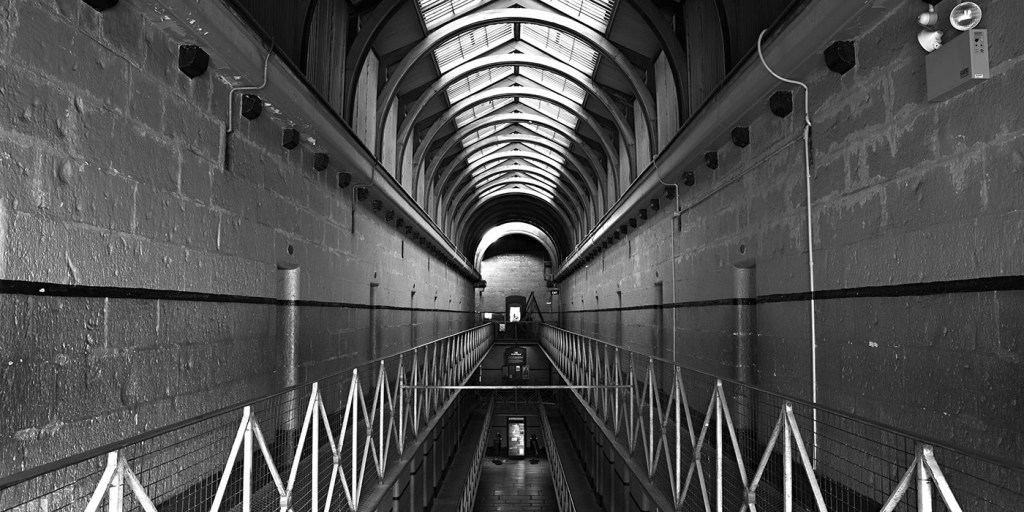
From 1842 until its eventual closure in 1929, the Melbourne Gaol bore witness to a harrowing series of 133 executions, with its solemn grounds bearing witness to the ultimate fate of Australia’s most notorious figure – the outlawed bushranger, Ned Kelly. In the present day, a pilgrimage to the hallowed halls of the Old Melbourne Gaol offers an opportunity to delve into the bygone existence of the men and women who both endured and met their demise within its somber confines, affording an immersive encounter with history’s echoes.
The History
The History – First Execution in 1842
In the annals of history, a select group of Tasmanian Palawa individuals found themselves transported to Victoria at the behest of George Augustus Robinson, the Chief Protector of the Port Phillip Aboriginal Protectorate. Their mission: to aid in the suppression of the Victorian Koori community. Against the backdrop of Western Port Bay, this assembly of five Tasmanians—Tunnerminnerwait, Maulboyheenner, Truganini, Planobeena, and Pyterruner—joined the tumultuous frontier wars, unleashing a wave of violence that reverberated across the District of Port Phillip. Tragically, two whalers fell victim to their actions, leading to the execution of Tunnerminnerwait and Maulboyheenner, despite the defense put forth by Redmond Barry. The duo’s hangings on January 20, 1842, unfolded outside the walls of the Melbourne Gaol, with Judge John Walpole Willis shaping their punishment to serve as a deterrent against similar infractions by the local Koori populace. In a morbid spectacle, the Melbourne population converged to witness the agonizing strangulation of the two men during a botched hanging—a vivid testament to the collision of cultures that eventually marked the initial occurrences of Aboriginal men comprising five out of the first nine executions in Victoria.
End of Ned Kelly’s Legacy
Ned Kelly, the enigmatic bushranger, remains an enduring figure within Australia’s folklore—a multi-dimensional hero whose narrative has captivated the imaginations of countless individuals. Following an intense eighteen-month pursuit and a controversial trial, Kelly met his fate on the gallows of the Gaol on November 11, 1880. Ned Kelly was the 101 Individual executed at the Gaol.
His notoriety as a horse thief, bank robber, and murderer rendered his apprehension imperative, subsequently setting off a chain of events that sustained the Kelly legend. His demise sparked unrest in Melbourne and beyond, prompting an exhaustive inquiry into police actions. Furthermore, his remains saw a peculiar fate; souvenirs were purportedly collected upon his disinterment in 1929, and in 1978, what was believed to be his skull was pilfered from the Gaol—a saga that perpetuated the mystique surrounding this compelling character.
Gaol reopens in 1942
The historic Melbourne Gaol once served as a military guardhouse, specifically designated to detain soldiers who had gone ‘absent without leave’ or engaged in public intoxication. Evidently, the conditions within the Gaol during that era mirrored those endured by prisoners throughout the nineteenth century. This striking continuity in conditions paints a vivid picture of the penal atmosphere prevalent during that time.
Remarkably, the Gaol’s historical role expanded to include housing a handful of World War II prisoners-of-war, each with their own stories etched into its walls. Among them, Lieutenant Edgardo ‘The Fox’ Simoni, an Italian escape artist, graced the Gaol’s confines. Additionally, Captain Theodor Detmers, the German sea captain notorious for sinking the HMAS Sydney in 1941, found himself within these walls. Detmers vociferously voiced his dissatisfaction with the conditions, alleging violations of the Geneva Convention—a testament to the challenging circumstances that even those captured in the heat of global conflict had to contend with.
The pages of history also recount the presence of U.S. soldier Eddie Leonski, a strangler responsible for the deaths of three Melbourne women in 1942. Leonski’s proximity to the Gaol’s premises materialized as he was temporarily housed in the City Watch House, located adjacent to the Gaol. His presence, awaiting trial before an American military tribunal across Russell Street, serves as a somber reminder of the multifaceted narratives interwoven within the Gaol’s historical tapestry.
The Gaol during Gold Rush
During the epoch of the Gold Rush, the Old Melbourne Gaol embarked on a transformation that mirrored the rapid changes sweeping through Melbourne. Originally inaugurated in 1845, the Gaol’s first cellblock served as a rudimentary structure. However, the discovery of gold in 1851 sparked an extraordinary influx of people, propelling Melbourne’s population from 23,000 to an astonishing 90,000 within just four years. This dramatic surge in inhabitants, drawn by the allure of newfound riches, engendered a substantial predicament for the Gaol—a crisis of overcrowding that demanded swift solutions.
The resonance of this overcrowding was so profound that the Argus newspaper articulated the dire circumstances in 1853, employing vivid language to convey the plight: the old cellblock was figuratively “crammed to suffocation.” It was within this pressing context that a pivotal evolution unfolded. It wasn’t until 1859 that a second cellblock came into fruition, offering respite from the congestion that had gripped the Gaol.
This new cellblock, while hewing to a design reminiscent of its predecessor, exhibited a refreshing departure. Referred to by the Argus as having an “aspect of greater airiness and cheerfulness,” this fresh architectural endeavor was characterized by a modern, forward-thinking layout. Innovation took root within its walls, evident through elements such as improved ventilation, a reliable supply of clean water, and a food hoist that streamlined the provisioning process. Recognizing the importance of physical activity, the new cellblock embraced the provision of ample exercise yards. Moreover, it embraced the technological advances of the era by harnessing steam power in various domains—including the bath-house, wash-house, and kitchen—further enhancing the overall conditions for the incarcerated.
As the Gold Rush reshaped Melbourne’s landscape and demographic composition, the Old Melbourne Gaol adapted in tandem, striving to transcend its origins as a mere confinement facility and embracing progressive principles that sought to cater to the well-being and basic needs of those within its walls.
Final chapter of the Old Melbourne Gaol’s history
Although officially closed in 1924, the Gaol retained its somber significance until its decommissioning in 1929. During this transitional period, a poignant episode unfolded within the confines of the Exercise Yard, echoing the macabre fate of executed inmates.
In a profound gesture, the bodies of those who had met their end at the hands of the gallows were exhumed from the Gaol’s cemetery. This process, initiated to accommodate the Gaol’s eventual closure, had a disquieting effect. As members of the public looked on, a peculiar rush ensued as individuals descended upon the freshly opened graves, seeking to acquire mementos. Among these graves, a particular fervor surrounded the remains believed to be those of the infamous Ned Kelly. His purported bones became coveted relics, with spectators seizing the opportunity to claim a fragment of his legacy.
Within this atmosphere of fascination and curiosity, a contractor seized a skull from the same coffin, thereby inciting further intrigue and speculation. This event, occurring in the midst of the Gaol’s winding down, sparked a renewed investigation into the whereabouts of Ned Kelly’s remains, illuminating the profound impact his story still wielded over the collective imagination.
The subsequent fate of these exhumed bodies unfolded in Pentridge Prison in 1929, where they found their resting place in mass graves, a location that remained concealed until the year 2008. It was during this period that the remains of Ned Kelly were finally identified, bestowing a measure of closure as they were ultimately returned to his family. The remains of others, too, were reverently reinterred on the grounds of Pentridge.
Yet, amidst these revelations, a shadow of mystery endured. The whereabouts of Ned Kelly’s skull persisted as an enigma, casting a haunting aura over the saga of his life and death, leaving a piece of his legacy forever intertwined with the unknown.
Melbourne Gaol swungs open once again in 1942
The doors of the Melbourne Gaol swung open once again in 1942, albeit under vastly different circumstances. This time, the Gaol assumed a new role, operating as a detention barracks for Australian soldiers. In a twist of fate, the very institution that had confined criminals and witnessed executions would now house servicemen who had gone ‘absent without leave’ or had been found inebriated within town limits.
Curiously, the conditions prevailing within the Gaol during this period harked back to an earlier era. It’s intriguing to note that the conditions faced by these military detainees bore striking resemblances to those endured by prisoners throughout the nineteenth century. The echoes of history resounded as the Gaol, which had once been a symbol of punishment, saw its environment reimagined to accommodate soldiers in a state not dissimilar to their criminal predecessors.
As the world found itself enmeshed in the throes of World War II, the Gaol’s significance took on a global dimension. A handful of World War II prisoners-of-war found themselves confined within its walls. Among them was Lieutenant Edgardo ‘The Fox’ Simoni, an Italian escape artist whose exploits had earned him a notorious reputation. Captain Theodor Detmers, the German sea captain who had infamously sunk the HMAS Sydney in 1941, also experienced a period of confinement within the Gaol. Notably, Detmers registered formal complaints against the conditions he faced, alleging that they violated the Geneva Convention—a poignant reminder of the intersection between the laws of war and the practicalities of detention.
Amidst these narratives, the Gaol’s history took yet another chilling turn. In close proximity, U.S. soldier Eddie Leonski, a convicted strangler responsible for the deaths of three Melbourne women in 1942, found himself housed adjacent to the Gaol in the City Watch House. Leonski’s path to justice led him to an American military tribunal situated on the opposite side of Russell Street.
The re-opening of the Melbourne Gaol during this chapter of history underscores its remarkable versatility, transitioning from a symbol of criminal justice to an unconventional detention facility for military personnel during times of global conflict.
Mystery of Ned Kelly’s Skull
In 1972, the Old Melbourne Gaol was transformed into a museum, showcasing a presumed skull of Ned Kelly. Stolen in 1978, the skull’s disappearance left a void, but in 2009, it was recovered, ending its mysterious journey.
A DNA test on a tooth from the skull definitively proved it wasn’t Kelly’s. His 2008 Pentridge disinterment revealed a skull fragment, disproving claims of decapitation since 1880. Yet, the true owner of the skull remains a mystery, despite the clarity about its non-Kelly origin.
This blend of scientific scrutiny, historical revelation, and lingering enigma exemplifies how artifacts intertwine with narratives, delving beyond Kelly to the broader mysteries that history beckons us to explore.
Check out What’s On in Melbourne Goal or visit their website at https://www.oldmelbournegaol.com.au for more details.
Location Address: Old Melbourne Gaol
377 Russell Street
between Victoria & La Trobe St
Melbourne Victoria 3000

 Local Vic