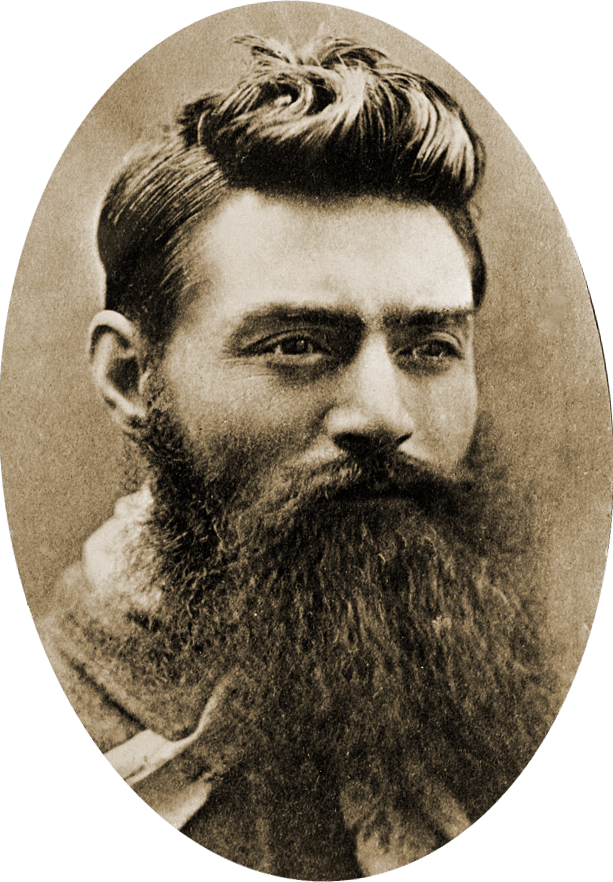
The armour. The siege. The last stand at Glenrowan. The words ‘Such is life’ that may or may not have actually been said are all stories we have heard about Ned Kelly for nearly 150 years.
But here’s the thing about local versions of stories; they tend to sand off the complicated bits. And the real Ned Kelly story is all complicated bits. Its messy, contested, deeply human, and far more interesting than the myth we ended up with.
Who was he, really?
Edward Kelly was born in 1854 or 1855 (records are inconsistent) in Beveridge, north of Melbourne, the third child of John ‘Red’ Kelly, an Irish convict transported for stealing two pigs, and Ellen Quinn, whose family had a complicated relationship with the Victoria Police that predated Ned’s birth. He grew up in poverty in the north-east of the colony, in a region where Irish Catholic selector families and the largely Protestant colonial establishment didn’t exactly get along.
By the time he was fifteen, Ned was already known to police. By twenty-three, he’d shot three policemen at Stringybark Creek. This was the act that launched the most dramatic outlaw saga in Australian history and kicked off a manhunt that lasted nearly two years.
Whether those three officers’ deaths were murder or self-defence is something historians still argue about. Kelly always maintained the police came to Stringybark Creek to kill him. The police, naturally, maintained otherwise.
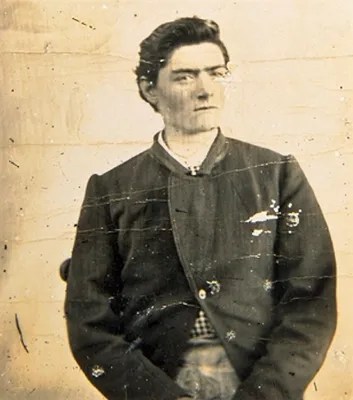
The making of a myth
What turned Kelly from wanted criminal to folk hero was partly timing and partly the Jerilderie Letter This letter was an 8,000-word document he dictated in 1879 that is simultaneously a justification for his actions, a coherent political argument about class and colonial injustice, and one of the most remarkable pieces of writing in Australian history.
In it, Kelly doesn’t just defend himself. He takes on the entire apparatus of colonial power with the police, the courts, the land system. All this squeezed families like his onto marginal selections while wealthy squatters held vast tracts of country. He writes with fury and with clarity, and whether you think he was a cold-blooded killer or a political revolutionary, it’s hard to read the Jerilderie Letter and not understand why people chose a side.
The armour, built in secret from ploughshares while the gang hid in the bush, became a symbol of that defiance. Four suits, hammered out by hand, designed to make the gang invulnerable to rifle fire. It worked on the torso. It didn’t account for the legs.
Glenrowan and the end of Ned Kelly
The siege at Glenrowan in June 1880 is one of the strangest events in Australian history. Kelly and his gang took over a hotel, held sixty hostages, tore up a section of railway line to derail the police train, and then somehow also allowed a schoolteacher named Thomas Curnow to slip away in the night and warn the train. When Ned Kelly emerged from the hotel in the early morning, alone, in full armour, and walked toward the police line firing, it was the act of a man who knew it was over.
He was shot through the legs, captured, tried in Melbourne, and hanged on the 11th of November 1880. He was just twenty-five years old. Ned Kelly was hanged at Melbourne Gaol.
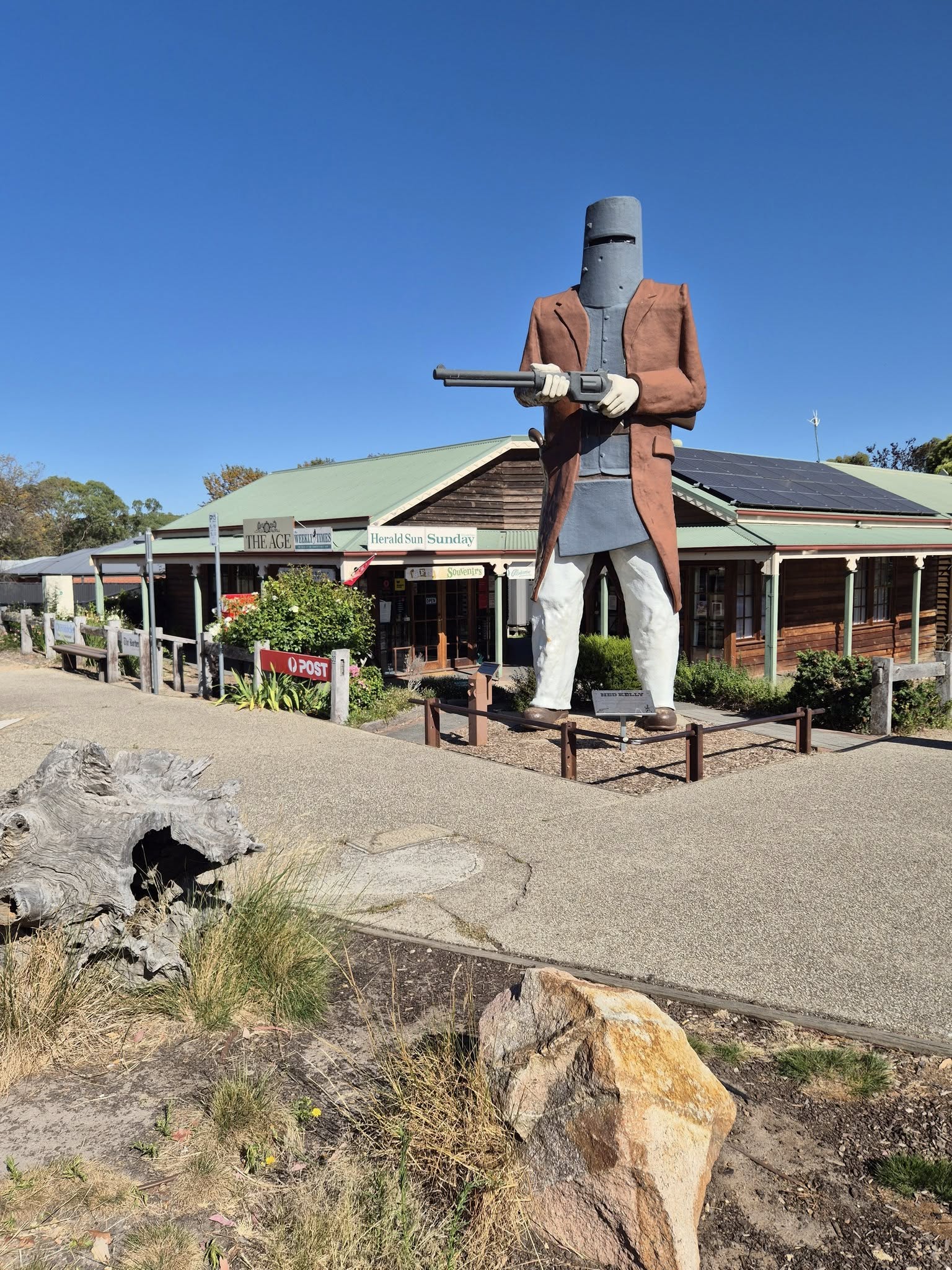
What does he mean to us now?
The question of what Ned Kelly means to the locals doesn’t get easier with time. He was a killer. but a product of a system that was explicitly designed to disadvantage people like him. He was a criminal but also someone who was articulate, strategic, and driven by something that looked a lot like genuine political conviction.
Sidney Nolan painted him. Peter Carey won the Booker Prize writing him. Mick Jagger once wanted to play him in a film. He’s on tea towels and in art galleries and in every tourist shop from Beechworth to Benalla.
And yet, underneath all the iconography, there’s still a real person in there. Many remember him as a young man from a poor family in north-east Victoria who made a series of escalating choices, some understandable, some terrible, and who ended up becoming the thing Australia couldn’t stop talking about.
The more you learn about Ned Kelly, the more you want to unravel.
Currently you can get to see Ned Kelly’s armour at the State Libray Melbourne on display in the Redmond Barry Reading Room.
About Ned Kelly – Recommended Resources
The Big Ned Kelly – https://www.australiantraveller.com/vic/big-ned
Gladstone St &, Kate St, Glenrowan VIC
Kates Cottage Kelly Homestead & Museum – http://www.katescottageglenrowan.com.au/ned-kelly-museum
Contact Phone (03) 5766 2448
Wikipedia: https://en.wikipedia.org/wiki/Ned_Kelly

 Local Vic