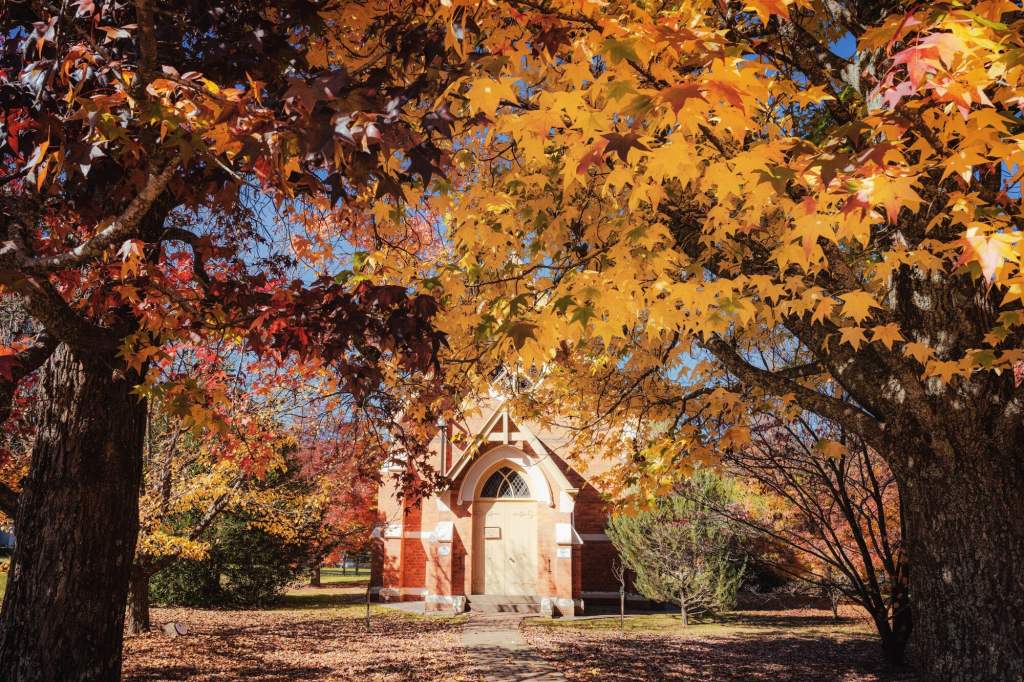
Every autumn, the town of Bright fills with tour buses and day-trippers who’ve seen the Instagram images and want the red maples and the golden elms of the Ovens Valley. Bright is beautiful but often too crowded to really enjoy your time out. Instead travel a bit further to visit Jamieson which is just 90 minutes further away and offers something older and quieter.
Jamieson rests quietly at the meeting point of two rivers, cradled by mountains first carved open during the gold rush. More than 160 years on, it feels much the same — small, unhurried, and especially beautiful in autumn.
Once a busy supply hub for the goldfields of Gaffneys Creek and Woods Point, Jamieson thrived when the diggings were alive with promise. When the gold faded, so did the crowds. The town gently shrank back, settling into a slower rhythm that has endured ever since. Today, with a population of around 100 people, Jamieson remains peaceful and deeply picturesque — its paddocks edged by converging rivers and its streets glowing each autumn with the rich colours of deciduous trees planted by miners in the 1860s who, in many ways, never truly left.
Jamieson: A town that shrank and stayed beautiful
Local Legend: From 4,000 to 100 — and Why the Trees Are Still Here
Jamieson grew up as a supply depot, not a goldfield. When gold was discovered at Cashines Flat south of town in 1854, and more importantly when the rich fields of Gaffneys Creek opened in 1859, Jamieson became the essential resupply point for miners working their way into the remote Upper Goulburn valley. Supplies were transported by horse and mule through the mountains along treacherous trails. At the town’s height, it held a population of between 3,000 and 4,000 people — with five hotels, each with its own orchestra, two breweries, banks, insurance offices and a courthouse. It may have been the most entertainingly incongruous town in Victorian colonial history: a full civic infrastructure buried in the High Country ranges, serving a transient population of gold-hungry men.
Then the gold thinned, the A1 Mine at Gaffneys Creek mechanised and shed workers, and Jamieson slowly emptied back toward the mountains. What it left behind were the fruit trees planted by Dr Nash in the 1860s (still growing at The Island), the maples and elms and oaks that the miners’ descendants planted along the streets, the courthouse, the stories, and about 100 people who know they live somewhere exceptional and have decided to stay quiet about it.
The town was named after George Jamieson, a shepherd who lived in the area in the 1850s. The name stuck even as the population surged and collapsed around it and the courthouse on Nash Street where the Historical Society now keeps its collections still anchors the same main street that five-hotel Jamieson built around a riverside junction. Walking it now, you understand the particular quality that Australian gold rush towns have when they were purpose-built but then gently abandoned: the buildings are solid but the scale is wrong for the current population, and that wrongness is exactly what makes them atmospheric.
Jamieson Town – The Autumn Circuit
The island where two rivers meet
The town’s most atmospheric single spot: a grassy peninsula (called The Island, though technically a confluence rather than an island) where the Jamieson River meets the Goulburn River. Fruit trees planted here by Dr Nash in the 1860s still stand and still fruit.
In autumn the combination of the old fruit trees, the river birches and poplars, the reflected sky in the still water before the current picks up at the junction, and the surrounding mountains is one of the finest natural compositions in the Victorian High Country. Platypus have been spotted in the calmer sections of the river near here — best chances at dawn and dusk.
The Island is part of the town’s Heritage Walk. An off-leash dog area is located nearby. The Heritage Walk, Significant Trees Walk and Cemetery Walk all pass through or near this section — pick up a map from the General Store or the Courthouse Museum before you set out.
Significant Trees Walk & Heritage Walk
Two overlapping self-guided walks that are best combined in autumn: the Significant Trees Walk identifies individual specimens of particular age and character — maples, elms, oaks, a Magnolia Grandiflora at the Courthouse Hotel corner planted around 1865, Giant Sequoias along the memorial avenue, and poplars that turn pale gold in the afternoon light. These are trees planted by the gold rush generation, now 150 years old and enormous.
The Heritage Walk adds the built history: the Courthouse and Museum on Nash Street, Juddy’s Hut (an example of an early miner’s cottage), St Peter’s Anglican Church surrounded by century-old oaks, and the signposted historic sites along the main street. The combination of extraordinary trees and intact heritage architecture makes Jamieson’s walking scene unlike anything else in the High Country.
Jamieson Arboretum
A formal planted arboretum on the edge of town offering a concentrated display of the exotic and native species that make Jamieson’s autumn so visually rich. The elevated position gives views over the town and toward the surrounding mountain ridgelines — one of the few spots where you can see the full context of Jamieson’s valley setting in a single frame. Good picnic facilities, quiet even in peak season. In autumn the arboretum glows with colour from mid-morning through late afternoon.
The tree-lined streets come ablaze in gold, copper and bronze. Bright green in spring and summer — and all shades of yellow, red and golden when their leaves turn in autumn. Trees planted by miners who arrived in the 1860s, still in place, still doing what they were planted to do.
Camping the Jamieson & Goulburn Rivers
The rivers around Jamieson offer some of the finest free camping in Victoria — grassy sites on the riverbank, fire pits, drop toilets, and the sound of the current all night. The quality of these sites is disproportionate to their profile: free, first-come-first-served, and managed by Parks Victoria.
The key planning note is the seasonal closure window for Grannys Flat: open only from October to June. The autumn window (March–June) is ideal — sites are at their best, the light through the riverside poplars and peppermint gums is extraordinary, and the leaf fall from the deciduous trees at Grannys Flat turns the ground copper.
Grannys Flat
Jamieson River · 7.5 km gravel from town · Free
The best-known of the Jamieson river camps. Grassy level sites right on the Jamieson River, shaded by poplars, peppermint, Blue Gum and wattle, with steep native forest slopes rising around the flat. Facilities include drop toilets, picnic tables and fire pits. The Gallows Track 4WD route leaves directly from the campground. Mitchell’s Bridle Trail (24km walking and horse riding track) also starts here. Open October to June only — perfect for the autumn window. Boil all water. 7.5km unsealed access road with a steep entry section.
Wrens Flat
Jamieson River upstream · More remote · Free
Further upstream from Grannys Flat on the Jamieson-Licola Road. A smaller, quieter site with a park-like atmosphere shaded by Blue Gum, Blackwood and exotics including old apple trees — another trace of the gold rush’s pastoral settlers. The lower sites are quite flat. Good trout fishing access. Similar facilities to Grannys Flat. Access via continuing the unsealed road past Grannys Flat.
Goulburn River sites — Kevington to Knockwood
Goulburn River · Multiple sites · Free
Beyond the township of Kevington heading toward Knockwood and Gaffneys Creek, hundreds of riverside campsites line the Goulburn. These are more remote and more varied — some immediately roadside, some requiring short walks to the river. The road follows the Goulburn through dense mountain ash forest with views of the ranges above. In autumn the tree canopy along the river is extraordinary. No facilities at most sites — completely self-sufficient camping required.
Jamieson Caravan Park
Jamieson River · In town · Powered sites & cabins
For those who prefer facilities, the caravan park on the Jamieson River is set on six acres of park-like terrain with beautiful old deciduous trees and direct river frontage. Two-minute walk to the town centre. Powered sites, solar-heated pool, cabins. The autumn leaf fall from the old trees in the park makes this a genuinely lovely site even for those who aren’t camping tourists.
Goulburn River Loop: The Road Into Gold Rush Country
The most rewarding driving in the Jamieson area follows the Goulburn River valley east from town — a route that passes through the Upper Goulburn Historic Area and accesses some of the most atmospheric backroads in the High Country. This is the road to Kevington, Knockwood, Gaffneys Creek and ultimately Woods Point — the most remote continuously inhabited community in Victoria. You don’t need to go all the way to Woods Point to feel the quality of the landscape: even the first 30 kilometres from Jamieson to Kevington pass through scenery that rewards unhurried driving.
Jamieson to Kevington — the Goulburn Road
From Jamieson heading northeast, the sealed road follows the Goulburn River upstream. For a significant portion of the route the road runs right beside the river — the Goulburn is clear, fast-running mountain water, alternately shallow gravel beds and deep pools in the bends. In autumn the mountain ash and peppermint gum along the banks turn warm gold, and the dappled light through the canopy creates the characteristic Goulburn Valley driving experience: cool, dim, the river appearing and disappearing between the trees, occasional wide-sky moments where the valley opens. Kevington has a pub — the Kevington Hotel — that is among the most genuinely remote country pubs accessible without a 4WD in Victoria, and is worth the drive for that alone.
Jamieson–Licola Road: Into the Alpine Country
South of Jamieson, the Licola Road climbs into the foothills of the Alpine National Park. The first 20 kilometres are sealed and reach Grannys Flat reserve. Beyond Grannys Flat the road becomes gravel and continues south toward Licola through some of the most spectacular river gorge country in the High Country. The section from Grannys Flat further south is a full day’s commitment — the road is slow, the river crossings require attention in wet weather, and Licola is a long way. But for those who want to camp at Grannys Flat and explore the surrounding ranges on a second day, this road provides access to Mitchell’s Bridle Trail and the tracks leading up onto the ridges above the Jamieson valley.
Walks of the Jamieson District
| Walk | Distance | Time | Notes | Grade |
|---|---|---|---|---|
| The Island & river confluence | 1–2 km loop | 30–45 min | Flat. The most atmospheric short walk in Jamieson. Best at dawn and dusk for platypus sightings. Fruit trees, riverside poplars, mountain views. Part of Heritage Walk. | Easy |
| Heritage & Significant Trees Walk | 4km town loop | 1.5–2 hrs | Combined walk through the heritage streetscape and significant tree specimens. Self-guided, maps from Museum. 150-year-old specimens throughout. Best in autumn peak colour. | Easy |
| Mt Margaret Sappers Track | 3 km return | 1.5 hrs | Climbs from the Brewery Bridge along a historic military track to views of the town and valley. Especially rewarding in autumn when the canopy below is coloured. Moderate incline throughout. | Moderate |
| Mitchell’s Bridle Trail | 24 km one way | Full day | Starts from Grannys Flat, follows the Jamieson River to Mitchell’s Flat. Horse riding and walking. Generally easy gradient following the river valley. One of Victoria’s great riverside trails. Arrange return transport or camp at Mitchell’s Flat. | Easy–Moderate |
| School Hill Walk | 2 km return | 45 min | Steep climb to the mobile phone tower above town, with spectacular views described as “panoramic” across the surrounding mountain country. Best in clear autumn weather when the ranges are sharp against the sky. | Steep |
| Tunnel Bend Reserve (near Knockwood) | Short loop | 30 min | On the Goulburn Road past Kevington. A water diversion tunnel dug in 1866 to allow alluvial mining of the river bed — extraordinarily visible piece of engineering heritage in a lovely riverside setting. Easy walk from the reserve car park. | Easy |
Eating & Drinking in Jamieson
For a town of 100 people, Jamieson has an implausibly good range of food and drink options. This is the legacy of its position on the road to Mt Buller — the through-traffic from Melbourne skiers has kept Jamieson’s hospitality culture alive through the non-ski months. In autumn the food and drink scene is at its most relaxed and genuinely welcoming.
Jamieson Brewery & Grill
5953 Eildon–Jamieson Road · On the Goulburn River
One of Victoria’s first boutique microbreweries, on 8 acres of parkland with the Goulburn River running past the back door. The former Lakeside Hotel — the first hotel licensed on the 550km Lake Eildon shoreline. The American Brown Ale and Irish Red are consistently praised. Kids zone inside, parkland gardens outside. The best venue for a group meal after a day on the rivers. Book ahead on weekends.
Courthouse Hotel
Nash Street · Opposite the Catholic Church
155-year-old pub in the centre of town — open fires in winter and autumn, cold beer year-round, a reputation for genuine hospitality and country pub meals that fill you up. The kind of place where locals come in at 5pm and the conversation moves from farming to football to whatever you’ve been doing all day. Heartland Jamieson hospitality in its most direct form.
Jamieson General Store
Main Street · Coffee, food & provisions
The daily-needs anchor of the town — groceries, fishing gear, camping accessories, ice, and a coffee setup using Mansfield Coffee Merchant beans that reviewers consistently praise. Hot food, cold drinks, confectionery, fudge and local information. Visitor info available. The café tables outside give a view of the main street’s autumn canopy. Essential first stop on any Jamieson morning.
Perkins on Grey Café
Corner Perkins & Nash Street · Leafy garden setting
A small café in a leafy garden overlooking the surrounding hills — cakes, coffee, hot and cold beverages, sandwiches and focaccias. Gluten-free and vegan options. The garden setting in autumn, with the deciduous trees around the café at full colour, gives this modest venue an atmosphere well beyond its size. Best for a slow mid-morning stop after the heritage walk.
Kevington Hotel
Kevington · 18 km from Jamieson
One of the most genuinely remote pubs accessible without a 4WD in Victoria — on the Goulburn Road northeast of Jamieson. Country food, cold beer, and the particular warmth of hospitality that belongs to pubs that serve people who’ve driven a long way to get there. Stop for lunch on the Goulburn River loop. The pub has a simple but honest menu and is well worth the detour.
Wili’s Thai Junction
Old Colonial Bank Building · Thu–Sun dinner
An unexpected and genuinely good Thai restaurant in the old Colonial Bank building — the kind of surprising quality that occasionally appears in small High Country towns when the right people decide to stay. Sit-down dining Thursday to Sunday. The combination of the heritage bank interior, the small-town atmosphere and a well-executed Thai menu is one of those only-in-Jamieson experiences.
Location & distance guide to Jamieson
225 km from Melbourne
Route Guide: Melbourne – Maroondah Hwy – Yea (75 min) – Eildon (Lake views) – Jamieson (Town & rivers) Grannys Flat (River camp) – Goulburn Rd loop (Towards Kevington) – Kevington (Historic pub) -Return via Mansfield or stay overnight


