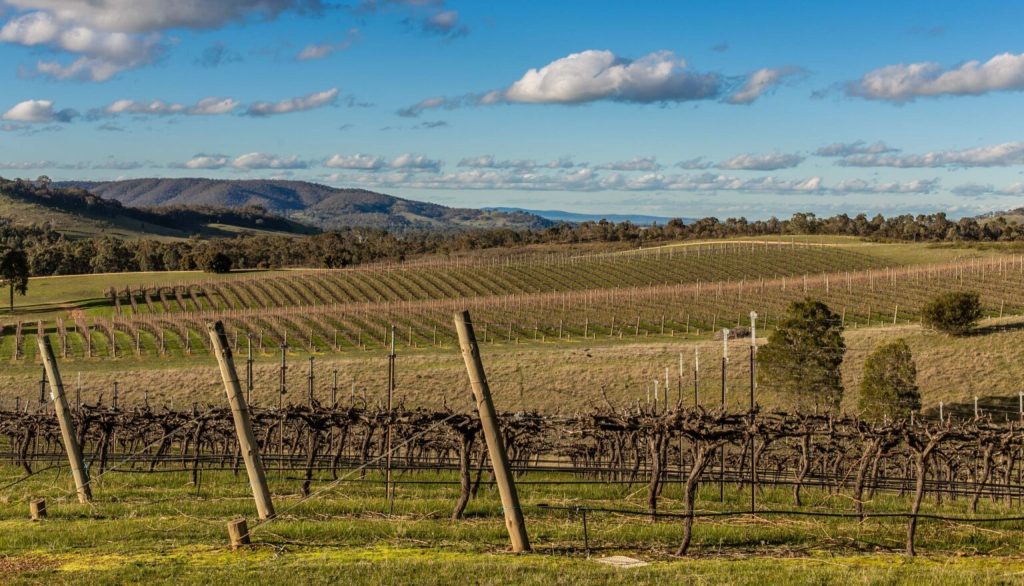
The Pyrenees Ranges are the southern extension of the Great Dividing Range in Victoria. They are not dramatic peaks but a broad granite massif rising from the Wimmera plain to the north and the Goldfields country to the south. Altitudes range from 300 metres on the lower slopes to over 750 metres at Mount Avoca, the highest point. The Avoca River rises in these ranges and flows north, cutting a gentle valley that runs through the centre of the wine region.
The geology does the heavy lifting here. The soils are acidic, sandy loams loaded with quartz grains with low fertility, well-drained. Its the kind of soils that stress the vine just enough to concentrate flavour without preventing ripening. The high sunshine hours through the growing season drive full fruit development, while the cool nights at elevation extend the process and it is this combination that produces the characteristic Pyrenees red: full-bodied but not jammy, with spice and structure that comes from genuine phenolic ripeness at moderate alcohol levels.
Route Guide:
180 km from Melbourne: Day trip can be done but ideal for a weekend getaway.
Melbourne – Western Ring Rd – Ballarat (Coffee stop) – Avoca (Wide-street town) – Moonambel (Cellar door cluster) – Taltarni & Dalwhinnie (Benchmark producers) -Warrenmang (Lunch & views) – Landsborough (Valley & pub) – Return via Beaufort
The Pyrenees named themselves twice. First, Thomas Mitchell named them in 1836 — a Scottish army officer who had served in the actual Pyrenees between France and Spain, looking at these granite ridges rising from the Victorian plain and seeing something familiar in the silhouette. Then Rémy Martin, the French Cognac house, planted the first modern vines here in 1963 — drawn, perhaps, by the same quality of light, the same character of open country and rolling slope. Both men were right.
There is something about this landscape that does not feel entirely Australian. The wide horizons, the pale grass, the vine rows catching the autumn afternoon: it feels older, quieter, more European in its composure. And still — almost entirely free of the tourism machine that processes Bright every March.
From 16,000 Miners to 25 Cellar Doors
In September 1853, a party of prospectors travelling through on their way to Bendigo found gold in the Pyrenees Ranges near Avoca. Within ten weeks the population of the settlement — previously a handful of squatters had gone from 100 to 2,200. By June 1854 there were 16,000 people in the district working the Avoca Lead and surrounding rushes. From 1859 to 1870, gold worth £2,500,000 was sent from Avoca to Melbourne and that figure likely represents only a third of actual production, as private sales were not included. The town Avoca established from this wealth became an administrative centre that outlasted the rush its wide main street was laid out to accommodate the movement of heavy equipment and large crowds, a design decision that now gives the town one of the most unusually spacious main streets in regional Victoria. Chinese miners arrived to work the old leads in the 1860s and made a significant mark on the district — Avoca’s Garden of Fire and Water reflects this heritage. The early vineyards planted from the late 1850s onward were eventually wiped out by phylloxera. A full half-century passed before the Pyrenees saw vines again, when Rémy Martin and its Australian partner planted at Chateau Rémy (now Blue Pyrenees) in 1963, specifically to produce brandy grapes. Table and sparkling wine ambitions followed, and the region now has almost 30 wineries and a solid reputation for shiraz and cabernet sauvignon that the original 19th-century producers would not have recognised.
Avoca: The Wide Street Town
Avoca is named after the Vale of Avoca in County Wicklow, Ireland and refers to “the meeting of the waters”. The town sits in a gently undulating basin at the foot of the Pyrenees, 181 km northwest of Melbourne and 72 km north of Ballarat. The extraordinary width of the main street with its central reservation creates a parkland strip between opposing carriageways is the gold rush’s most visible legacy: Avoca was planned to handle the movement of 16,000 people and the equipment they needed.
Today the wide street gives the town an unusual airiness. Heritage buildings line both sides at a distance that creates generous sightlines: the 1859 courthouse, the 1854 Bank of Victoria building, the Victoria Hotel complex with its stone ballroom dating from the late 1850s, the 1878 Gothic Revival primary school. For a drive with a specific interest in gold rush architecture, Avoca’s self-guided heritage walk (brochure from the Information Centre at 122 High Street) covers around 40 points of interest.
Garden of Fire and Water: 24–30 Dundas Street · Free · Chinese heritage garden
A contemplative heritage garden acknowledging the Chinese miners’ contribution to Avoca during the gold rush of 1850–1870. A scholar rock (significant in Chinese tradition) stands at the entrance. An unusual and quietly powerful cultural marker in a town that doesn’t often market its Chinese heritage loudly. Guided tours available on request.
Avoca Heritage Walk: High Street precinct · 2–3 hours · Self-guided
A pamphlet walk covering 40 points of historical interest, most on High Street. The gold rush buildings are dense here: courts, banks, hotels and churches built within five years of the first discovery. The Information Centre at 122 High Street is open daily and can supply maps and local information.
The Wine Region: Moonambel and the Benchmark Producers
The hamlet of Moonambel is a cluster of houses, a pub, vineyards in every direction and is the heart of the Pyrenees wine region. The original eight wineries of the 1970s and 1980s were all centred on Moonambel and Avoca. A second wave in the 1990s extended plantings north toward St Arnaud and south toward Landsborough. Today the region has over 25 cellar doors and produces wines that consistently rate among Victoria’s best in the full-bodied red categories particularly shiraz and cabernet sauvignon grown on the lower slopes of the ranges.
Dalwhinnie
The benchmark Pyrenees producer and the one wine writer Huon Hooke calls the “sweet spot” of the region hitting it more often than anyone else, including elder statesman Taltarni. Established at Moonambel in 1976 by architect Ewan Jones on 120 hectares at 595 metres elevation, the vineyard has been producing seriously collected shiraz and cabernet sauvignon for nearly 50 years. The little cellar door perched on the hill understates everything: the wines are anything but modest, and the views overlooking the Pyrenees backdrop from the deck are exceptional. Cheese platters available. Come for the view, stay for a bottle.
Taltarni Vineyards
‘Taltarni’ is Aboriginal for ‘Red Earth’ and the deep red soils of this vineyard at 420 metres above sea level, with gravelly quartz and clay, do produce wines of distinctive character and depth. Founded on the Chateau concept by American John Goelet in the 1970s using traditional French winemaking methods, Taltarni is known for its sparkling wines as much as its reds which are the méthode traditionnelle sparkling and are among the best in regional Victoria. The cellar door experience is described by visitors as unhurried and genuinely hospitality-driven: the staff are knowledgeable and generous. Charcuterie boards available to pair with the tasting flight. Bookings recommended for groups.
Warrenmang Vineyard & Resort
Owned and operated for over 40 years by veteran restaurateur Luigi Bazzani who is a personality in his own right will give you a full explanation of every wine and shares history of the vineyard if you visit when he’s around. On Sunday mornings, a guided tour of the underground cellar and barrel hall is available. The restaurant set high on the hill has sweeping views, axe-cut timber beams and a stone fireplace that is at its best in autumn and winter. The Black Puma shiraz is the wine the region knows Warrenmang for. Kangaroos frequent the property at dawn and dusk. Accommodation cottages available for overnight stays.
Blue Pyrenees Estate
The direct descendant of the Rémy Martin 1963 venture is now called Blue Pyrenees, with a cellar door and restaurant open every day of the year. The scale is different from the boutiques: 300+ acres of vines, award-winning sparkling wines that are among the most accessible in the region, and a full range of table wines. The cellar door is the most consistent opening hours of any producer in the region and the best option if visiting mid-week or if you want a guaranteed experience.
Dogrock Winery (by appointment)
A small, family-owned operation on the western flank of the Pyrenees at Crowlands has 5 Red Stars from James Halliday and Gourmet Traveller’s best small cellar door for the Pyrenees/Ballarat region in 2016. Real wine, minimal intervention, sustainable practices: the antithesis of the large estate model. Riesling, chardonnay, shiraz, grenache, tempranillo and cabernet sauvignon, all from estate fruit. Appointment required, but the effort is very much repaid.
Mount Avoca
Australian Certified Organic, 5 Red Stars James Halliday, and one of the region’s most interesting producers for variety alongside cooler-climate shiraz and sauvignon blanc, Mount Avoca grows nebbiolo, lagrein, tempranillo and sangiovese on picturesque organic vineyards surrounded by 1,000 olive trees. The cellar door has BBQ facilities, a children’s play area, and is genuinely family-accessible. The eco-luxe lodge accommodation in the vineyard makes this a very good overnight base.
Driving the region where light moves across hills
The Pyrenees is not a demanding drive to navigate but require stops at the cellar doors which are spread along a network of sealed roads between Avoca and Moonambel (can be looped in either direction), and the roads themselves are the landscape. These are not dramatic mountain roads but something quieter: gentle curves through open wine country, the vine rows running perpendicular to the road so that each gap between them gives a flash of the ranges beyond, the pale grass of the unfenced paddock edges bright in the low-angle light, kangaroos in the early morning and late afternoon grazing at the roadside margins.
Taltarni Road: The Spine of the Region
The road connecting Avoca and Moonambel via the Taltarni and Dalwhinnie estates runs through the core of the wine region’s original plantings. In autumn, the vine rows on either side of this road are at their peak copper-gold colour from mid-March through May, and the views northeast toward the Pyrenees ridgeline are clearest in the morning before haze develops. Driving slowly (this is a narrow sealed rural road on 60 km/h appropriate) and stopping frequently is the intended mode. The number of places where you will want to pull over for a photograph will surprise you.
Landsborough Valley Road: The Quietest Loop
From Moonambel, heading northwest to Landsborough takes you into the second major district of the Pyrenees wine region which is a long valley between Landsborough and Elmhurst. This is where a significant wave of vineyard planting occurred in the 1990s. The valley has a different character to the Moonambel slopes: lower elevation, wider, with views across more open pastoral country to the ranges on either side. The Landsborough Hotel in the village is one of those genuinely old country pubs where the value of a simple lunch and a cold Pyrenees red after a morning of cellar doors becomes self-evident.
Return via Beaufort & Pyrenees State Forest
The return to Melbourne via Beaufort (south from Avoca on the Pyrenees Highway) passes through the southern end of the wine region and gives access to Pyrenees State Forest for short walking and picnic stops in the ranges proper. Beaufort has a good café and small arts scene, and the road south toward Ballarat passes through the most visually striking section of the Great Dividing Range’s southern foothills with narrow valleys, remnant dry forest and the occasional creek crossing. Allow 2.5 hours minimum from Avoca to Melbourne via Beaufort, 2 hours via the Calder Freeway.
Cafés, Pubs & the Pyrenees Table
Warrenmang Restaurant
Mountain Creek Road, Moonambel · Lunch & dinner
The destination lunch venue of the Pyrenees wine region. Rustic in the best sense with stone fireplace, axe-cut timber beams, a stone wine cellar below and a panoramic deck above. The Black Puma shiraz pairs perfectly with whatever seasonal menu Luigi and his team are running. Book ahead, especially on Sundays when the underground cellar tour runs in the morning.
Landsborough Hotel
Main Street, Landsborough · Pub lunch
The Landsborough Hotel is the kind of country pub that the food media writes about in regretful retrospectives after they’ve gone. Great value lunch, local wine, genuine country hospitality. Serving the agricultural community of the Landsborough valley since the gold rush days. Sit in the front bar. Order the daily special.
Avoca cafés and bakeries
High Street, Avoca · Morning stop
Avoca has several cafés on the wide main street that serve as the logical start or end of the day. None are famous beyond the district but all serve honest coffee and food in a heritage setting. The Avoca Hotel on High Street opens early and has that quintessential gold-rush pub atmosphere with stone floors, high ceilings, a front bar that has been serving travellers since 1854.
Pyrenees Unearthed Festival
Avoca · April annually
Avoca’s annual wine and food festival falls in April which is also peak autumn and brings together the region’s producers for tastings, food pairing events and winemaker dinners across the weekend. Timing the drive to coincide with Pyrenees Unearthed turns a cellar door visit into a full regional festival experience. Check visitpyrenees.com.au for annual dates and programming.
March to May is the period the wine industry calls “senescence”, its the vine closing down for winter, drawing nutrients from the leaves back into the wood, the chlorophyll retreating and exposing the yellow, orange and red pigments beneath. In the Pyrenees, this happens slightly later than in the cooler regions to the east and south: the vine rows on the lower-elevation Moonambel slopes can hold their colour into late May in warm autumns, making this a genuinely extended season rather than a narrow window.
Winter (June–August) is cold, occasionally frosty, and very quiet. The cellar doors are still open (check hours for smaller producers) and the landscape has its own character: bare vine rows against pale grass, the ranges clearer in the dry winter air, fog in the Landsborough valley at dawn.
Avoid harvest season (February–early March) if you want cellar door access: producers are occupied, hours may be reduced, and the landscape is at its least photogenic green and the vines heavy with unripened fruit. Come when the work is done.
Location & distance guide to Pyrenees Region
Drive via Western Ring Road to the Western Freeway (A8), through Ballarat, north on the Pyrenees Highway (A300) to Avoca.
Total: approximately 2.5 hours from Melbourne CBD, 45 minutes from Ballarat.
The more scenic approach runs via the Sunraysia Highway through Ararat, approaching Avoca from the north-west adds 20 minutes but passes through the most visually interesting section of the ranges foothills.
No rail connection to Avoca (the line closed in 1979). The drive is the journey.
Notes
- All roads in the region are sealed and accessible in any weather for standard 2WD vehicles. The Moonambel–Avoca loop via Taltarni Road is approximately 35 km and takes 45–60 minutes including stops but I am not counting cellar door time.
- Most smaller cellar doors are open Friday–Monday only. Blue Pyrenees is the most reliably open seven days. Check individual winery websites before visiting as hours change seasonally and some boutique producers require appointments.
- Accommodation is available in Moonambel (Summerfield studios, Warrenmang cottages, various B&Bs), Avoca (motels and the renovated Bank building suites), and Landsborough (caravan park with new ensuite cabins).


